Sony offers two lenses considered to be “general purpose” or “walkaround” lenses for their APS-C E-mount cameras like the A6000 series:
•The 16-50 f3.5 – 5.6 power zoom lens which is tiny and compact and offers a motorized zoom ideal for shooting video. This lens sells for $100 when purchased as a bundle.
•A high-end 16-55 constant f/2.8 “G” lens that sells for over $1000 USD.
So one lens is 10x the cost of the other. Is the expensive one 10x better? Let’s do a quick test: I took two pictures of the really cute subject under ideal conditions; one with each lens. 100% crops from both appear below (click on image to view larger and sharper):
"Deepfakes" have been around for years, like this Coca-Cola commercial mixing living and dead celebrities. But how can you prove if a video hasn't been manipulated?
(Note: This is an expanded version of the article I wrote for Cameracraft magazine. I'm sharing it now because the idea needs to be out there. Plus, I was on tap to give a TEDx talk about this subject in April 2020, but of course it was cancelled due to pandemic concerns. So I'm putting it out there. The world needs this invention!)
Once upon a time there was a saying: “The photograph doesn’t
lie”.While mostly true, you could still
lie in the old days by attaching false captions or using a forced perspective.Lying by manipulation came much later -- it
was used heavily by the Soviets during the time of Stalin, and then by the
advertising industry (which is synonymous with lying, really) with the
invention of the Scitex imaging workstation in the 1970’s.But the ability to really lie via
manipulation didn’t reach the masses until Photoshop came along.
1989. US Ambassador Vernon Walters presents photographic evidence at the United Nations Security Council, supporting his claim that a Libyan MiG-23 shot down by US fighters had been armed. “It is untrue!” exclaimed the Libyan ambassador. “The pictures were fabricated; they were directed in the Hollywood manner!”
People (journalists and academia, mostly) started to sound
the alarm in the 1970s about how you can’t rely on the photograph for
evidentiary purposes anymore.And I
started to collect examples of famous photo manipulations in history which made
a difference (good and bad).Some
historic examples are sprinkled throughout this article.
Back in my NASA days I identified this as a problem that
needed solving – in my view, society was relying too heavily on the image whose
sanctity was eroding, and I made it my mission to restore it.
The Importance of Pre-Visualizing Your Image In my seminars I give examples of how pre-visualizing your images before you even pick up your camera is the single best thing you can do that will result in high-impact photos. It helps you solidify in your mind the rules of composition you're employing, and increases your awareness of your lighting and your backgrounds. If your goal is to have people say "Wow!" to your images, this technique gets you there faster than, say, buying more gear.
Going further, to help me in this regard I'll sometimes sketch out my compositions first. To wit:
The sketch (left), and the final product (right).
I also use this technique at the beginning of a photo session so I can get my idea across to my subjects. It also comes in handy in studio sessions, where I can get the equivalent of "writer's block" when deciding what pose to go for next.
Two years ago I profiled a photographer for Cameracraft magazine named Cheryl Walsh; she took these wonderful fantasy underwater portraits in her backyard swimming pool. (Click on any image to view larger.) She has won multiple awards for her work, but back when she was just beginning she had a huge, seemingly insurmountable problem: Her prints didn't look nearly as good as they looked on her screen. From the article:
I don't usually bring home souvenirs from my travels... in my mind my photos are the memory jog of the times we had. (Besides, after awhile your house gets just too cluttered.) But I made a small exception with my trip to the Soviet Union back in 1988, to document a cultural exchange between Soviet and American High Schools Students. (You can see my work on that project here.)
This Russian Pepsi bottle is symbolic of that era - back then, the Soviet Union's Ruble was a closed currency; it couldn't be traded in the open market and therefore large Western companies couldn't sell their goods to this large market. The mangers at Pepsi had a work-around for that - they would barter Pepsi Cola for Russian Vodka, and then sell it abroad. Brilliant business practice. I've kept that bottle all these years, and decided to memorialize it with a proper photo for the archives.
But photographing clear objects is hard. You can't just take a picture of it with a flash and have it come out looking impressive. You need to have the glass refract some light in order for the shape of the bottle to be visible, yet otherwise perfectly clear.
Things I discovered about the A7R IV and RX100 VII
How to post to Instagram from your Computer
More! (Including new eBooks!)
Things I discovered about the A7R IV and RX100 VII Normally I try to shy away from camera-specific blog posts, so humor me a bit since you're unlikely to find this information anywhere else. Let's start with the amazing 61 megapixel A7R IV, the ebook of which should be out within a couple of weeks. I was going through each menu (as I always do) to see what's changed, and I came across a new item in the "Send to Smartphone Function" menu (below). "What in the world is THAT?"
Group shots and wide angle lenses usually go together. Which can be a bad thing for people standing near the edges, for that's where distortion is the greatest. The problem becomes noticeable with large groups in tight spaces, for it means the camera is necessarily close to the group.
Here's an example group shot, taken in 2011 during my first seminar in Copenhagen. The group looks great, but look at the people at the edges (yellow rectangles) (click on any image to view larger and sharper):
Interesting Things I Discovered about the Sony RX100 VII
BTS on a Hollywood Movie Set
Recently I did some Behind The Scenes stills for a Hollywood movie called "The Treasure of Pirate's Cove". It's a kid's film that borrows heavily from every action film genre in the last 50 years including Indiana Jones, National Treasure, and [generic pirate time travel movie plot here]. Actor Malcolm McDowell played the ship's captain, and I have to tell you it's a joy to watch competent people in their element.
Thinking "This is a Hollywood Movie, so they'll be using lots of light" I left my f/2.8 and faster lenses at home. Turns out that was a mistake - even the daylight scenes were lit with no more than 3 diffused lights. And they were old LED light banks, which provided its own set of problems when you're shooting silently (as one must do for this kind of assignment).
Image stabilization for video is different than image stabilization for stills. That’s because the nature of the shake to be corrected is different. For video, the correction has to last longer and the shakiness may very well be more intense (like when you’re walking and shooting video at the same time, for example.)
That’s why most modern digital cameras have a different, more aggressive system for correcting video shake. In addition to whatever optical stabilization the camera offers, the more aggressive way takes advantage of the fact that the number of pixels in a video (even a 4K video) is far smaller than the number of pixels the sensor has. So the camera might shoot a little wider than what you see in the viewfinder, and the camera compares adjacent video frames, aligns them (much like it does in HDR mode), and crops off the rest before merging it into the video stream. All in real time. The more you oversample (capture pixels outside of the intended frame), the more leeway you have for fixing a shaky hand.
I was reminded of this when I shot a very informal video giving a tour of my studio. Here it is, shot using an RX100 V and a small tripod-socket-based handle (mechanically similar to the VCT-SGR1 recently announced by Sony with their RX100 III vlogging bundle,) For this, the more intense "Intelligent Active" SteadyShot feature for movies was enabled:
As you can see, the shakiness of my hand often exceeded what the camera’s made-for-movies steadyshot could do. It bugged me a lot, but when I posted it to my youtube channel, only one person complained. (On the other hand, this is Youtube, where even the worst production values raises the average.)
Is there anything I can do in post-processing to smooth this out?
"Your Mother has stopped accepting food and water. Hospice has been called. You'd better get back here."
That shocking news came when we were 4 weeks into a 5-week trip. And it had been quite a whirlwind before I left early to fly home. Let me tell you what it was like. This will necessarily be a short blog post.
The trip began with a stop in Pennsylvania for my niece's college graduation. (Click on any image to view larger) (and sharper).

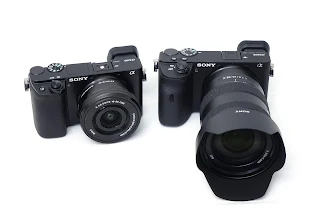
 Sony offers two lenses considered to be “general purpose” or “walkaround” lenses for their APS-C E-mount cameras like the A6000 series: