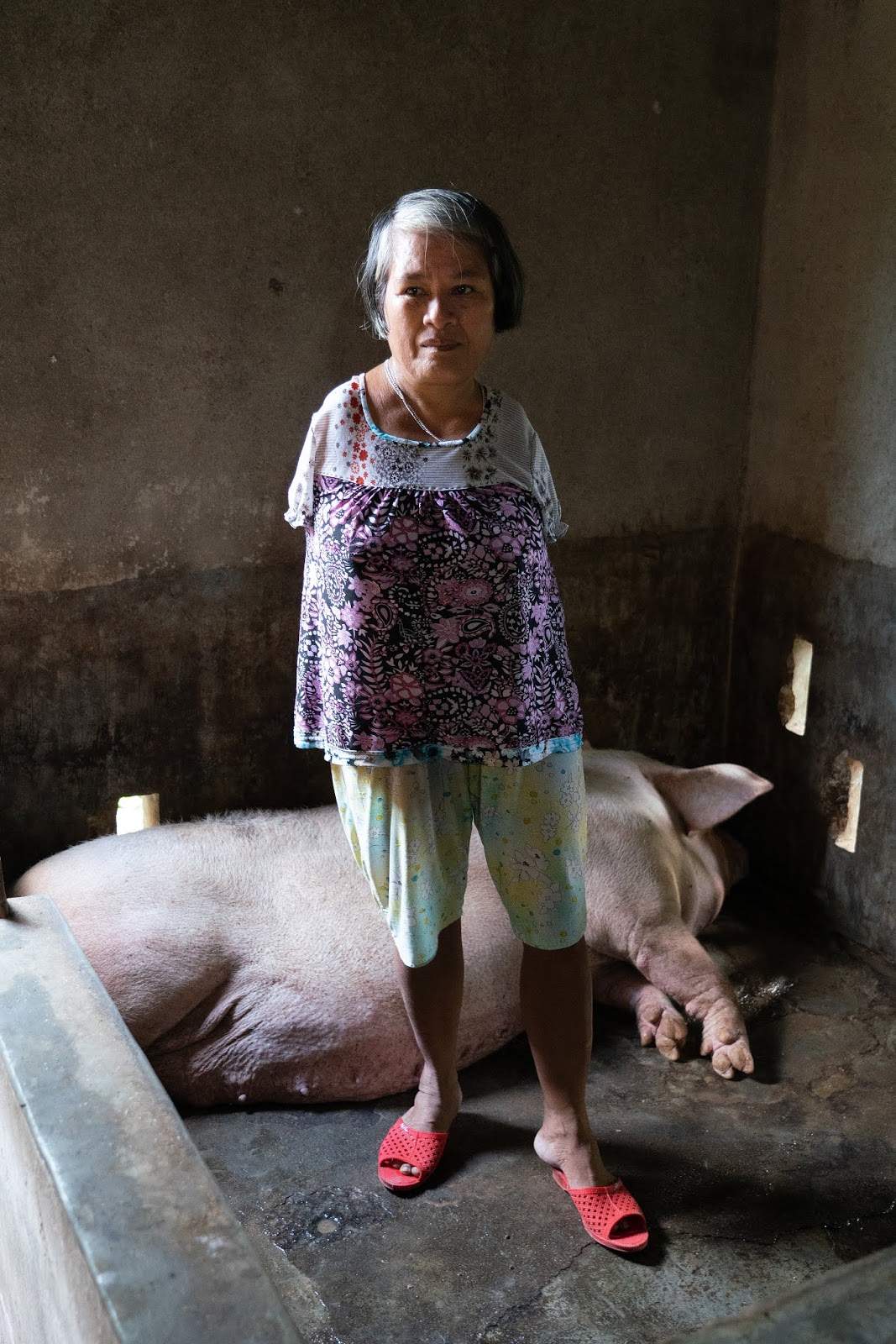
 I've just returned from Vietnam, on assignment with the organization Photographers Without Borders. On this trip I was to document the work of "Hearts for Hue", a humanitarian NGO looking to help rebuilt one of the hardest-hit cities of the Vietnam war - a war that, apparently, is still going on between the North and the South. My assignment was to tell the story of the positive difference the organization was making, via both stills and video. There are a lot of stories to tell, and of course many of you are interested in the technical side (including why I rarely kept the camera on straight "Auto"). So I'm splitting this story into two blog posts - in this one I'll share with you my pictures and stories. In the next post I'll talk about what the experience was like, the equipment I used, and what it's like working for Photographers Without Borders. You can do this kind of work for them too!
Thursday, January 3, 2019
The Faces of Vietnam (Part 1)
I've just returned from Vietnam, on assignment with the organization Photographers Without Borders. On this trip I was to document the work of "Hearts for Hue", a humanitarian NGO looking to help rebuilt one of the hardest-hit cities of the Vietnam war - a war that, apparently, is still going on between the North and the South. My assignment was to tell the story of the positive difference the organization was making, via both stills and video. There are a lot of stories to tell, and of course many of you are interested in the technical side (including why I rarely kept the camera on straight "Auto"). So I'm splitting this story into two blog posts - in this one I'll share with you my pictures and stories. In the next post I'll talk about what the experience was like, the equipment I used, and what it's like working for Photographers Without Borders. You can do this kind of work for them too!

The Faces of Vietnam (part 2)

In my last post, I showed you the highlights of last month's trip to Vietnam, documenting the humanitarian work of NGO "Hearts for Hue". In this post I'll talk about the behind-the-scenes stuff, including equipment, technique, and what it's like to work with Photographers Without Borders.
In order to be considered for an assignment with them you have to first become a member; I was one for two years before I approached them about shooting for one of their advertised projects. Several interviews ensued, and six weeks later I learned I had been chosen. There's a fee to participate; plus travel expenses. I was responsible for all of that. Fortunately I've been able to offset some of those costs thanks to the generous donations from people like you, my dear readers. :-)
"Use your highest-quality, full-frame camera!" they said, and so I brought my Sony A7R III and a variety of lenses, plus a backup for everything because I know how things go. Here's a picture of what I brought:
Tuesday, January 1, 2019
Encryption that Makes Everyone Happy

[Editor's note: This is a compilation of several posts I made over the years which discusses a solution to the seemingly intractable disagreement between law enforcement and privacy advocates over the encryption of personal data. This has little to do with photography.]
I think I found a solution to the Apple vs. FBI stalemate that requires no back door, maintains strong privacy, and still provides for legimate law enforcement access when there is a warrant. What do you think of this idea?1st Post - February 18, 2016
As often happens with politicized topics, there is much ignorance and lies being spewed by all parties when it comes to the encryption vs. privacy vs. government access vs. security debate. I'm not advocating mass eavesdropping; rather I'm talking about legitimate law enforcement needs to solve murders and kidnappings in cases where a warrant has been issued. (Traditionally, warrants have been the mechanism to keep power-hungry government officials in check.)
If you've been following this subject at all in the media, you'll be hearing two major arguments:
1) "Strong encryption prevents the government from preventing terrorism, therefore manufacturers must install 'back doors' to the encryption that the government can use to eavesdrop". (This has been proven to be propaganda, as there are no demonstrated cases where not having access to an encrypted channel would have prevented anything.)
2) "We want to help law enforcement, however if such back doors were to be installed, hackers would be able to access it too, allowing no shortage of evil to take place. Plus, the NSA and other officials have demonstrated that they're not as concerned about due process when it comes to overstepping eavesdropping authority. It would be a public policy disaster and U.S. tech companies would lose international business as confidence in their security drops."
The above set of arguments is what's called a false dichotomy; it implies that these are the only two options available. Throughout this argument, nobody - not even encryption experts - has talked about existing encryption algorithms which can meet everyone's legitimate needs without necessitating a back door. It's called (m,n)-threshold encryption, and it works like this: Instead of having one key (that can both encrypt and decrypt), or two keys (one to encrypt and another to decrypt), you can encrypt anything using m of n keys, meaning you can have multiple keys floating around, and any 2 or 3 (or whatever combination you choose) of those keys can decrypt the contents. You can also configure it to have just one of the keys lock but two of any of the other keys will be required to unlock. It can be custom-tailored to meet specific use cases.
How would this work in the case of a smartphone?
Sunday, November 25, 2018
Why I still like the A-Mount

Also in this issue:
- Food Photography Frustration
- Friedman Archives Seminars - Home Study Course is on sale!
The world may be obsessed with mirrorless camera bodies now, but when I'm working in the studio (and sometimes on location as well) I STILL love and prefer to use my A99 II A-mount camera. Part of the reason is the superior ergonomics; part of it is because it still feels like a balanced system when long and heavy lenses are attached. Part of it is it works natively with a ton of outstanding lenses I still own.
But part of it also are these useful features that the E-mount bodies don't feature:
But part of it also are these useful features that the E-mount bodies don't feature:
Friday, November 2, 2018
Fun with Green Screens, Part 2

Green screens are not as intimidating as you might think. Here's the link to my original Green Screen article which I wrote for Cameracraft magazine, which also includes a link for the free Photoshop plug-in you can use to knock out the green easily and accurately, with no "green halo" like you would normally get by just doing a color selection and erasing it.
Wednesday, October 3, 2018
The Best Camera for Street Photography

Just came from New York City, where I wanted to travel light and didn't want to be a target by carrying an expensive-looking camera around. Guess what camera I used? (As always, click on any picture to make it larger.)
Tuesday, September 11, 2018
What To Do When Your Light Sucks

If you've been following my blog for any length of time, you'll know that I vastly prefer to get the light and exposure right in the camera because there's just no substitute for good light. (I've even purchased huge strobes for great light out in the field!)
But that doesn't mean I always have control of things. Take yesterday, for instance. I was out bike riding with a family and I stopped when the father was taking a picture of his son in the worst light possible:
Sunday, August 5, 2018
Another Reason to Shoot 4K
Also in this issue:
- RX100 VI lens comparison
- Atlanta and Boulder seminars are coming up!
- Portrait Lighting Workshop - report
- Vietnam Update
- [More!]
Another Reason to Shoot 4K
Quick! How many cameras were used to make this cheezy video of my wife and me learning to play the "Ugly Stick" in a recent trip to Newfoundland, Canada?
Quick! How many cameras were used to make this cheezy video of my wife and me learning to play the "Ugly Stick" in a recent trip to Newfoundland, Canada?
If you said "Five", you should know I never travel with that many cameras.
Wednesday, July 4, 2018
What to Do with Old Family Snapshots

Also in this issue:
- Tools for digitizing photos without a copy stand
- Tools for documenting your family tree for future generations
- Video on A7 III and A7R III
- ... and more!
What to do with Old Family Snapshots
Some genealogist friends tell me that interest in one’s ancestors comes about every three generations or so. Which means those old B&W snapshots piling up in your parents’ attic might be valuable if not to you, but most likely to your descendants one day.
#NaturePorn Part 2

Also in this issue: Follow up on...
- Image Search on Local Hard Drive
- Encryption to resolve the Privacy vs. FBI debate
- Constraint Theory
- Chocolate and Bacon
Back in March I had started a local debate about how much manipulation is too much. On the one hand, over-processed images sell. On the other hand, it's dishonest and can go a little too far on the continuum of snapshots and artwork.
For years I thought I had the right balance, but then a commercial software app made these kinds of over-the-top images embarrassingly easy - even those who have never taken the time to master Photoshop can crank out this level of work. I could fill my website with crap like this, and possibly license more images. But I wouldn't be proud of any of it.
Friday, May 25, 2018
Giving back...
 |
| Before and After, in front of Mr. Roark's house. |
For over 100 years, there has been a "Big Brother / Big Sister" organization in the US, which pairs volunteers with at-risk kids in single parent homes to provide a caring adult role model. For over 20 years, starting in college and continuing well into my working life, I was just such a "Big Brother" to two fatherless boys.
[Yes, this relates to photography. Keep reading, as I segue into a way you can assist me in my continuing quest to give back... ]
Subscribe to:
Posts (Atom)
-
 So here I was, on my way back from Las Vegas, and I came across a run-down old building that has a certain "character". I pu...
 -
 Also in this issue: The Next Seminars Other Tidbits My New Favorite Travel Camera When it comes to travel photography, there was al...
 -
Also in this issue: How I shot the video Copenhagen, Colorado, and California Seminars are happening! A65 / A77 book is out, and timel...
